Expert support for public authorities on environmental noise


Public authorities need acoustic information they can understand and use within their responsibilities. KFB provides technical analysis, reviews and expert guidance, connecting the available evidence with clearly explained recommendations and their limitations.
An illustrative overview of expert support for public authorities. No individual assignment or institutional endorsement is represented.
The question
Environmental noise connects technical questions with different uses of space and the needs of people. Public authorities need to understand these relationships within their own responsibilities. The available information can vary in detail and purpose, making it important to establish what it supports and where uncertainty remains.
The starting question is therefore practical: what acoustic information does the authority need, and how can it be made useful to its work? KFB’s role is to help frame the technical question and provide expert support suited to it. This overview describes the principles of that support, from agreeing the brief to explaining the resulting opinion.
Agreeing the scope
Work begins by establishing the purpose of the assignment, the intended audience and the information already available. The authority and acoustic team clarify which questions require attention and what form of output will be useful. A review of technical materials, an expert opinion and practical guidance each place different demands on the work.
The agreed scope connects those needs with the analysis to be undertaken. It identifies the materials to be considered, the expected level of explanation and the boundaries of the assignment. Where the available information cannot answer a question, that limitation belongs in the brief and remains visible as the work develops.
Reviewing the evidence
Technical review considers the relevance of the available material to the agreed question. KFB examines the assumptions behind the information, the context in which it should be interpreted and the gaps that affect what can be concluded. A technical statement is considered alongside the basis on which it was made.
The analysis distinguishes information supported by the materials from matters that need clarification. Possible approaches to further work are discussed in relation to their purpose and the information they would require. The aim is to explain what the current evidence can support and what additional understanding would be needed for a more complete assessment.
From analysis to recommendations
The central step is turning technical analysis into an opinion whose reasoning can be followed. Findings are connected to the information reviewed, and recommendations explain why a particular course of further technical work or consideration is proposed. Qualifications remain alongside the conclusions they affect.
Where the question allows more than one approach, the opinion explains the options and the assumptions that distinguish them. It also identifies what remains unresolved. This gives the authority a clear account of the technical reasoning for its consideration. The value of the recommendation lies in its relevance and explanation; its eventual use depends on the authority’s own responsibilities and wider context.
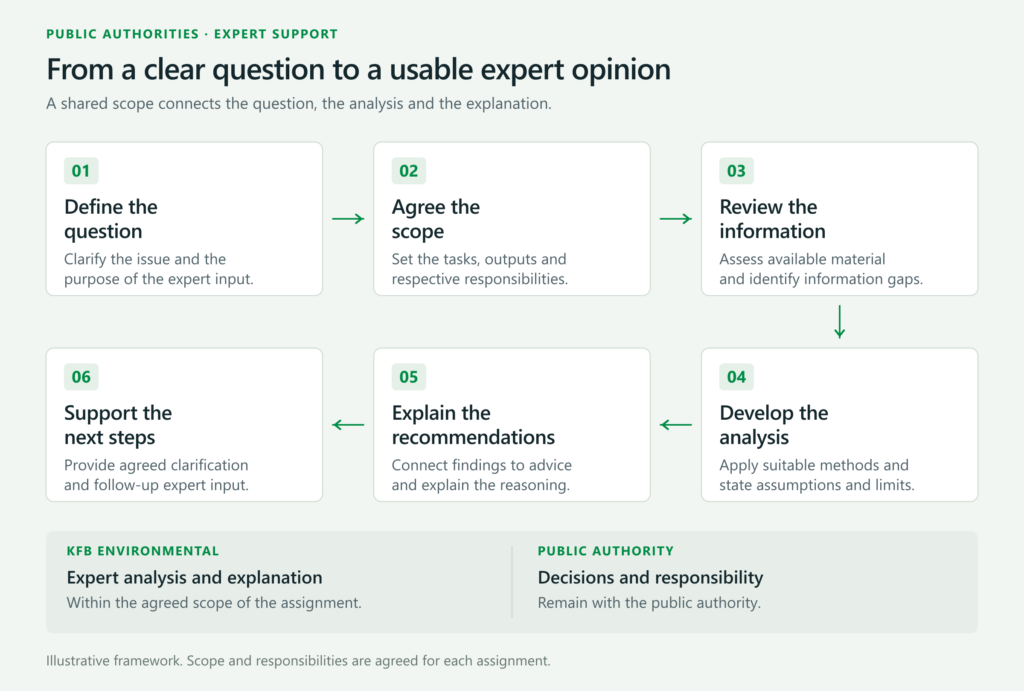
ILLUSTRATIVE PROCESS From an agreed question to explained recommendations and further technical support. Illustrative process; scope and responsibilities are agreed for each assignment. Decisions remain with the public authority.
Delivering a usable expert opinion
The output follows the agreed format and level of detail. Its structure brings the original question, supporting analysis and recommendations into a coherent account. Technical terms receive enough explanation for the intended readers, while the underlying reasoning remains accessible to those who need to examine it more closely.
Dialogue helps clarify the meaning and boundaries of the opinion. Questions about the analysis can be addressed alongside the written material, with limitations explained in plain language. Confidentiality also shapes the handling and presentation of information: the content and audience must reflect the agreed purpose and arrangements for the assignment.
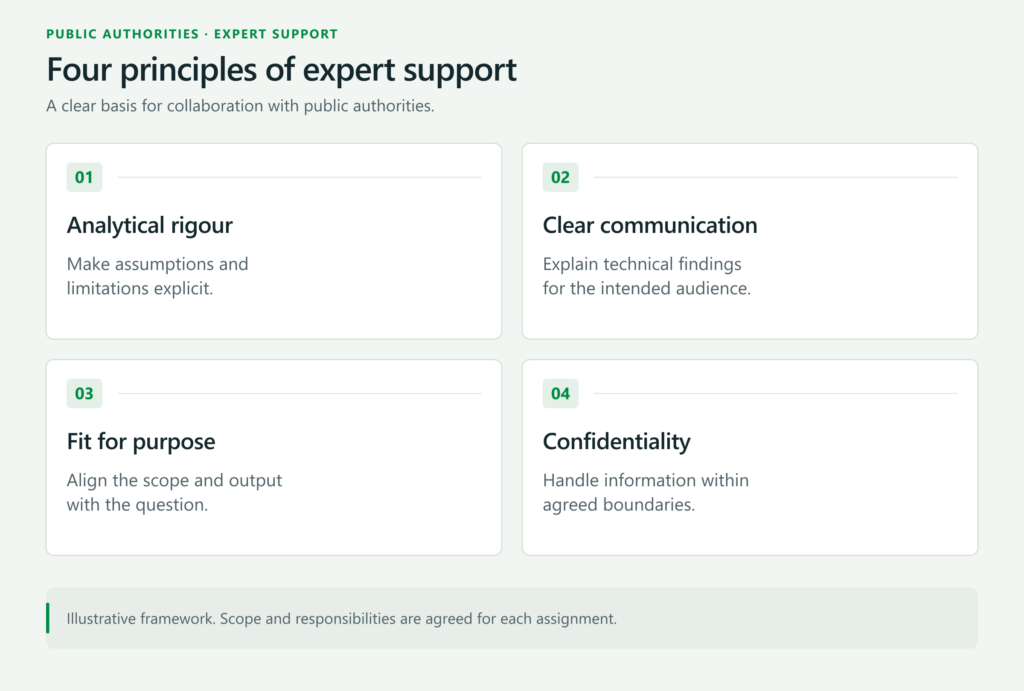
PRINCIPLES OF SUPPORT Analytical rigour, clear communication, fit for purpose and confidentiality guide the support. Original editorial graphic; no report extracts, project results or institutional endorsements are represented.
Supporting the next steps
Delivery creates a reference for further technical discussion. Within the agreed scope, KFB can explain the opinion, clarify its assumptions or discuss questions arising from its content. If additional analysis is needed, its purpose and boundaries are agreed before that work proceeds.
Responsibility for decisions remains with the public authority. Expert support contributes acoustic knowledge and explained recommendations within a defined remit. Keeping that remit clear helps the authority understand the contribution of the opinion, the questions it addresses and the limits of its application as its work continues.