Testing the environmental implications of a plant expansion before investment

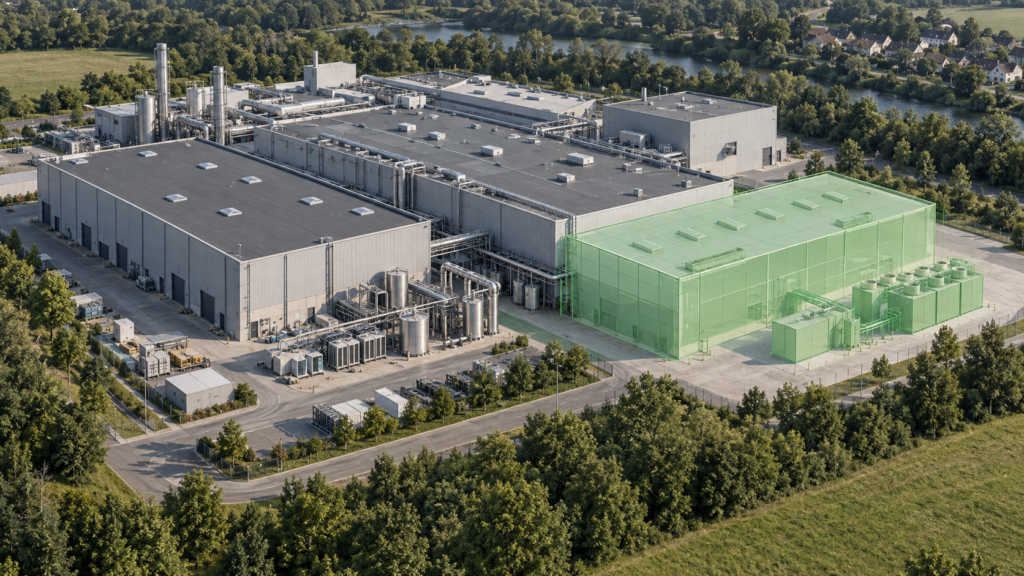
An expansion changes more than production capacity. KFB connects the existing plant, the proposed design and environmental assessments to compare options, examine uncertainty and recommend the measures needed before investment decisions are made.
Illustrative scenario: environmental assessment of an industrial expansion.
The brief
A large operating industrial plant is preparing to expand. The existing site is documented, an acoustic baseline model is available and the expansion design provides the planned layout, equipment and operating assumptions. The investor needs to understand how the expanded plant could affect its surroundings before committing to procurement and construction.
The question is broader than whether each new installation can meet an individual requirement. New processes can change emissions, water demand, drainage, waste streams, energy use and traffic, while adding to the pressures associated with existing operations. The assessment therefore considers the combined plant and the environmental topics relevant to its location and processes.
The purpose is a decision: which design and operating conditions are acceptable, where mitigation is needed, and which uncertainties must be resolved before the project advances.
Establishing the baseline
The starting point is a consistent description of the operating site: its geometry, installations, emission sources, operating modes, utilities and relationships with nearby receptors. Available measurements, operating records, environmental documentation and resource balances provide the evidence against which the expansion is assessed.
The scope covers air emissions, dust and odour; noise and, where relevant, vibration; water use, wastewater and stormwater; soil and groundwater protection; waste and material flows; energy use and greenhouse gas emissions; and land, habitats and landscape. The level of detail follows the relevance of each topic, rather than assuming that every issue requires the same type of model.
For acoustics, the existing model provides a calibrated baseline. Measurements used to adjust it are identified separately from any independent checking data. That calibration does not establish the reliability of air, water or other assessments: each needs its own evidence, assumptions and checks.
Building and checking the model
The proposed design is linked to the baseline through a coordinated digital representation of the site. Geometry and equipment data support the relevant calculations, inventories, balances and specialist assessments. The value lies in their connection to the same physical plant and design revision, not in a three-dimensional visualisation alone.
This is not a single universal environmental solver. An acoustic calculation, an emissions assessment and a water balance answer different questions. They need compatible operating assumptions, clearly defined boundaries and traceable source data so their findings can inform the same investment decision.
A complete design package still contains uncertainty. Supplier characteristics, production schedules, simultaneous operation and future resource demand may depend on conditions not yet demonstrated in practice. The assessment records these dependencies, checks the inputs and identifies assumptions that could change the recommendation. The proposed plant remains a forecast, not a measured operating condition.
Testing scenarios
The existing plant, the proposed expansion and feasible alternatives are compared on a consistent basis within each environmental topic. Depending on the project, alternatives may concern equipment selection, installation layout, operating schedules, emission controls, drainage, storage or resource recovery. Construction-stage effects are distinguished from those of normal operation.
The comparison looks across topics as well as within them. For example, an emission-control option may introduce additional energy demand or a new waste stream; a layout change may affect noise exposure, drainage and available land. These are relationships to test with project data, not assumed outcomes or reasons to favour one option automatically.
Sensitivity checks examine how credible changes in uncertain inputs affect the findings. Results retain their own indicators and units: noise, water demand and emissions are not merged into an unexplained single score. The investor can see the trade-offs, the strength of the evidence and the conditions under which each option remains viable.
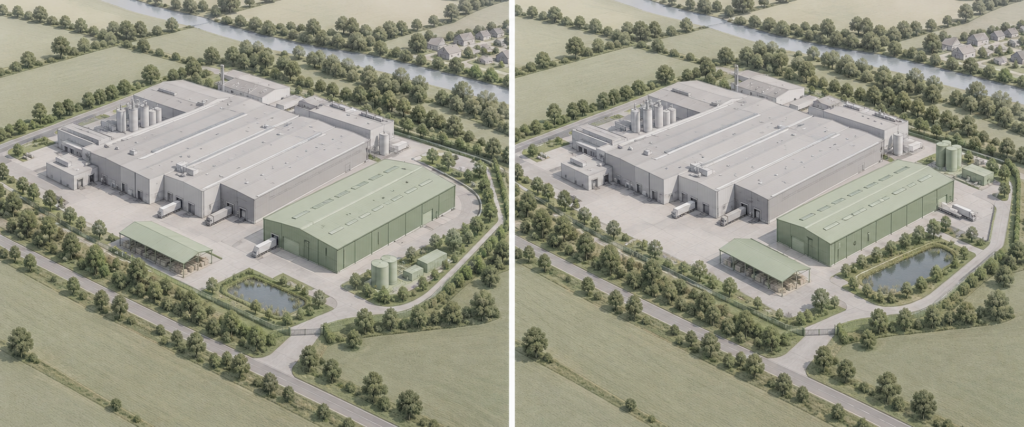
CONCEPTUAL ILLUSTRATION Illustrative layout alternatives for the same industrial site. Actual option comparisons require project data, consistent assessment conditions and topic-specific indicators; neither concept is presented as the preferred solution.
The decision and outcome
The central output is a recommendation on how to proceed. Options are assessed against the applicable environmental constraints, technical feasibility, operating needs, data confidence and, where cost information is available, investment and operating implications. A preferred option should be accompanied by the reasons for its selection and the conditions attached to it.
Where the design needs further work, the recommendation identifies the required mitigation, performance specifications or additional investigations. It also distinguishes actions needed before procurement from checks that can only be completed during commissioning or operation. This gives the investment team a practical basis for refining the project before money is committed. The agreed assessment then provides a reference for reviewing supplier proposals and subsequent design changes.
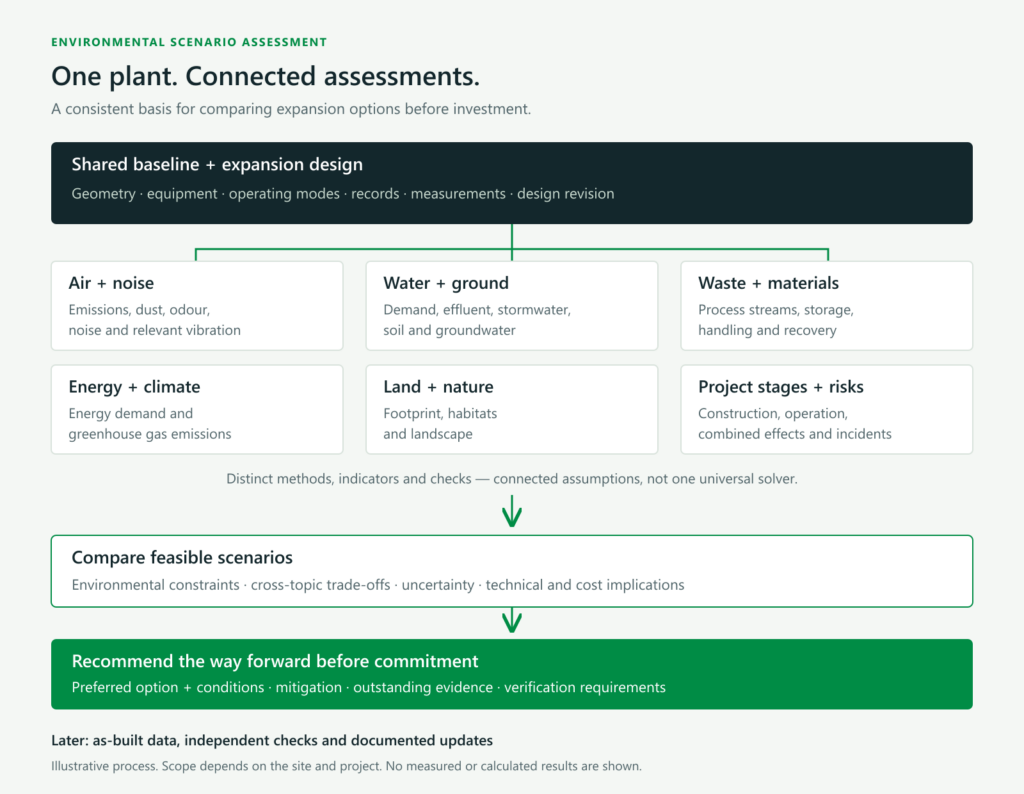
ASSESSMENT PROCESS One plant and one design reference, with distinct environmental assessments. Recommendations consider cross-topic effects, uncertainty and the conditions attached to each option.
Keeping the model current
Data and assumptions are checked at each stage, from design and procurement through construction, commissioning and operation. Changes to equipment, layout and operating conditions are reflected in the relevant assessments. Keeping the geometry, source registers, balances and calculations aligned with a documented site revision allows the team to revisit decisions as the project develops.
After implementation, as-built information, measurements and operating records provide a basis for checking forecasts and updating the model. Calibration data and independent checking data retain their separate roles, while comparisons between predicted and observed results help identify where further investigation or action is needed.
Where feasible, model inputs, assessment results and agreed actions can be linked to environmental reporting systems such as RAFA. Connecting this information with current site records can help teams review changing conditions, track follow-up actions and decide when a new scenario assessment is needed.